


Human Rights Now has released a report protesting the US government’s flagrant violations of international law and its attacks on the institutions and norms that protect human rights around the world under the second administration of President Donald Trump. This includes its withdrawals, retaliations, and undermining of international institutions and their personnel; its drastic reductions in foreign aid which threaten millions of persons depending on the aid for their survival; and regional destabilization through its attacks and threats of violence and coercion against other states, including its attack on Venezuela, its attacks and seizures of vessels in the Caribbean Sea, its threats against Gaza, and its treats against Greenland.
The full text of the report is available below and from the following link in PDF format: US_Report_2026.pdf
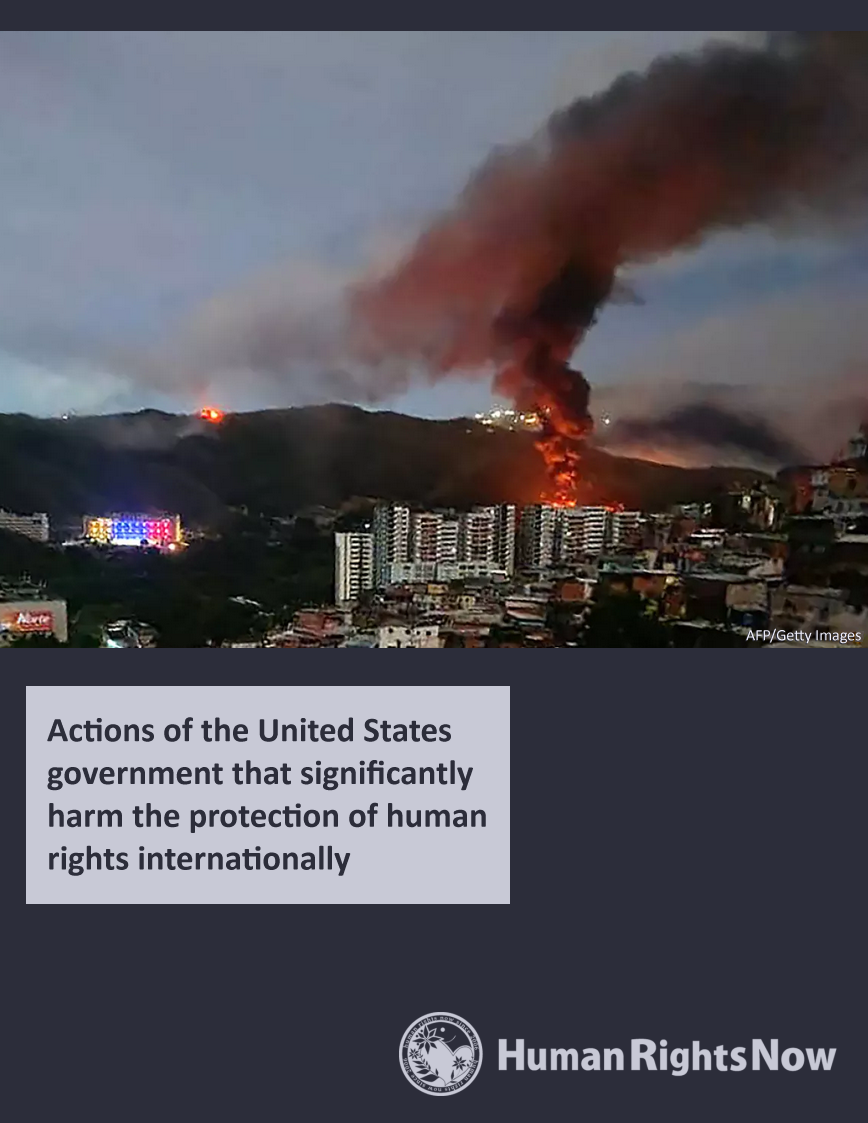
Actions of the United States government that significantly harm the protection of human rights internationally
Table of Contents
- Introduction
- Undermining rights-protecting international institutions
- Sanctions against International Criminal Court personnel and UN human rights officials
- Withdrawals from treaties and international organizations
- Drastic Reductions in Foreign Aid
- Dismantling USAID
- Cuts outside USAID
- Regional Destabilization
- Illegal attacks, threats, and seizures
- Attack on Venezuela
- Attacks on and seizures of vessels in the Caribbean Sea
- Threats against Gaza in the context of US supported attacks
- Threats against Greenland
- Illegal attacks, threats, and seizures
- Recommendations
- Annex 1: Negative Impacts of the Elimination of USAID
- Infrastructure breakdown and mission drift
- Harmful rhetoric motivating these changes
- Major reduction in aid access
- Harms of USAID cuts
- Harms to economic and social rights
- Adequate standard of living
- Protection of the family
- Physical and mental health
- Education
- Harms to civil and political rights
- Harms to economic and social rights
1. Introduction
Human Rights Now (HRN), an international human rights NGO based in Tokyo, expresses great concern over the second Trump administration’s flagrant violations of international law and its attacks on the institutions and norms that protect human rights around the world. This article is part of a series of statements on the ways the administration has committed and threatened human rights violations. We have previously examined the negative human rights impacts of the first several months of the Trump administration, including the rights violations associated with the US government’s illegal and abusive deportations, detentions, and targeting of migrants, women, minorities, LGBTQ persons, and other marginalized groups.[1]
President Trump’s disregard for international law, the rule of law, and human rights can be summarized by his answer to a reporter, who asked him following his illegal attack on Venezuela (which Venezuelan authorities report killed at least 100 people, following months of US arbitrary attacks on boats off Venezuela’s coast that have killed at least 115 people)[2] if there is anything that limits his power to strike, invade, or coerce other countries. Trump responded, “Yes, there is one thing. My own morality. My own mind. That’s the only thing that can stop me.”[3] When then asked what about international law?, Trump answered, “I don’t need international law. I’m not looking to hurt people,” and when asked directly if he abides by international law, Trump replied that while he does, it “depends what your definition of international law is.”[4]
We call on the US government to end the Trump administration’s plans to attack other countries and to reverse all orders and decisions that violate or threaten the US’s international human rights obligations and standards. The following sections review risks to human rights caused by the Trump administration’s undermining of rights-protecting international institutions, slashing of US foreign aid, and illegal attacks and threats against other states.
2. Undermining rights-protecting international institutions
The Trump administration has significantly weakened international institutions that protect human rights through sanctions, withdrawals, defunding, and hostile rhetoric. Instead of constructively engaging within multilateral frameworks, the US has taken unilateral actions that challenge the legitimacy and in many cases effective survival of these bodies.
President Trump and senior officials have repeatedly portrayed institutions like the United Nations as corrupt, inefficient, and hostile to US interests.[5] They have accused international organizations of supporting terrorism, enabling anti-Israel bias, and constraining US sovereignty.[6] These narratives have fueled both material and symbolic attacks on the institutions themselves and undermine their work protecting human rights.
2.1 Sanctions against International Criminal Court personnel and UN human rights officials
Among the most serious actions has been the Trump administration’s imposition of sanctions against personnel of the International Criminal Court (ICC).[7] In February 2025, it sanctioned ICC chief prosecutor Karim Khan[8] in retaliation for ICC investigations into the US’s conduct in Afghanistan and Israel’s conduct in the Gaza conflict, as well as warrants the ICC issued against Prime Minister Benjamin Netanyahu and former Defense Minister Yoav Gallant for war crimes, including starvation as a method of warfare, and the crimes against humanity of murder, persecution, and other inhumane acts. Khan and all ICC staff members were also banned from entering the US.[9] There are also secondary sanctions threatening to fine or imprison any person, institution, or company that provides Khan with “financial, material, or technological support.”[10] As a result, Khan lost access to his Microsoft email, and his bank accounts have been frozen.[11]
In June 2025, the US further levied sanctions on four ICC judges who authorized the aforementioned arrest warrants against Israeli officials and ICC investigation into abuses committed by US personnel in Afghanistan.[12] In August 2025, two deputy prosecutors and two judges were also sanctioned, and on 18 December 2025 two further ICC judges were sanctioned.[13] Some NGOs have ceased communicating with the ICC for fear of triggering penalties.[14] Sanctions increase the risk that other countries will refuse to cooperate with the ICC. This is a serious impediment to the ICC’s work, as NGOs assist the Court in various ways, including by helping to document crimes, and the ICC relies on state cooperation to facilitate its investigations and enforce arrest warrants. These sanctions fundamentally threaten the ICC’s independence and impede its ability to pursue justice in all its cases. 79 states made a joint communication stating that the “[s]anctions would severely undermine all situations currently under investigation as the court may have to close its field offices.”[15]
In July 2025, the US also sanctioned Francesca Albanese, the UN Special Rapporteur on the Occupied Palestinian Territory.[16] Secretary of State Marco Rubio alleged that Albanese had “directly engaged with the ICC in efforts to investigate, arrest, detain, or prosecute nationals of the United States or Israel, without the consent of those two countries.”[17] US sanctions severely impede UN mandate holders’ ability to investigate and report on human rights abuses.[18] They signal to all countries who are suspected of rights violations that cooperation is optional, and they unjustifiably encourage retaliation by states against UN officials.
Statements by US officials confirm the retaliatory nature of these actions. They are intended to punish UN officials for their work and pressure them against adopting conclusions unfavorable to US allies. Sanctions against the ICC judges were described as responses to “politicization and abuse of power.”[19] Albanese was accused of waging a “campaign of political and economic warfare against the United States and Israel.”[20]
Such intimidation and interference creates a chilling effect on human rights reporting and advocacy. It will dissuade future judges and experts from pursuing accountability for human rights violations committed by the US and its allies. Moreover, such accusations may facilitate and encourage other irresponsible states and actors to also retaliate against judges and mandate holders and obstruct their work with their own partisan and false accusations and obstructive conduct. Moreover, their future work may be marked with suspicions of having been swayed by US pressure.
Finally, placing sanctions on lawyers in retaliation for their work violates their right to freedom of expression and international standards under the UN Basic Principles on the Role of Lawyers. As Volker Turk, the UN High Commissioner for Human Rights, explains, “Sanctioning judges and prosecutors at national, regional or international levels, for doing their jobs, is an assault on the rule of law and corrodes justice.”[21] These sanctions are further incompatible with Article 16 of the Basic Principles on the Role of Lawyers, which states:
Governments shall ensure that lawyers (a) are able to perform all of their professional functions without intimidation, hindrance, harassment or improper interference; (b) are able to travel and to consult with their clients freely both within their own country and abroad; and (c) shall not suffer, or be threatened with, prosecution or administrative, economic or other sanctions for any action taken in accordance with recognized professional duties, standards and ethics.[22]
2.2 Withdrawals from treaties and international organizations
Over 2025, the Trump administration withdrew the US from several international organizations that, among other objectives, protect human rights, including the Human Rights Council,[23] the World Health Organization,[24] the Paris Agreement on climate change,[25] and UNESCO.[26] On 8 January 2026, it withdrew the US from a further 66 international organizations (31 UN organizations and 35 non-UN organizations).[27] These include numerous international organizations which intersect with human rights issues including the following list:
Education Cannot Wait, Freedom Online Coalition, Global Community Engagement and Resilience Fund, International Institute for Justice and the Rule of Law, Venice Commission of the Council of Europe, UN Economic and Social Council (ECOSOC), International Law Commission, International Residual Mechanism for Criminal Tribunals, Office of the Special Representative of the Secretary General for Children in Armed Conflict, Office of the Special Representative of the Secretary-General on Sexual Violence in Conflict, Office of the Special Representative of the Secretary-General on Violence Against Children, Peacebuilding Commission, Peacebuilding Fund, UN Democracy Fund, UN Entity for Gender Equality and the Empowerment of Women, and UN Register of Conventional Arms.
Even the US’s withdrawal from organizations which do not directly address human rights issues, such as those related to environmental protection, climate change, resource extraction, and economic development, may still have a significant impact on human rights, particularly in the developing world.
There is significant legal debate about whether the president has the practical and/or formal authority to withdraw from treaties and treaty-based international organizations unilaterally without Senate ratification.[28] This report is being released before the full response of the US Congress and courts has been made clear for all of these withdrawals. However, it is expected that the president’s attempt to withdraw from so many organizations, and the conduct of executive agencies in following his decision, will cause significant disruption and harm to both the international legal system generally and to every global issue covered by each organization specifically.
The rest of this section reviews possible human rights impacts from organizations from which the Trump administration withdrew the US in 2025.
The Human Rights Council (HRC) is a crucial institution for the global promotion and protection of international human rights obligations and standards. The US has always had a mixed record in its participation with the HRC, constructively promoting some human rights issues more than others. However, the complete US withdrawal by the Trump administration severely undermines all of the HRC’s work to protect rights by attacking its legitimacy and undercutting its effectiveness. Perversely, it even undermines the US’s own national interests by strongly signaling disapproval for peaceful relations of countries built on the rule of law and protection of basic rights. Rather than leverage US influence to shape the HRC’s focus in favor of human rights and the rule of law, the US withdrawal weakens the Council institutionally and empowers authoritarian voices within the Council to influence it in negative directions that undermine human rights and the rule of law globally.[29]
The other international institutions are also crucial for protecting human rights. Climate change is regularly described as “one of the most grave threats to the enjoyment of human rights,”[30] including to people’s rights to life, adequate standard of living, highest attainable standard of health, clean drinking water and sanitation, and other rights.[31] The illnesses that the WHO tackles are not only a threat to the right to health, but also the rights to life, food, housing, work, and the freedoms of association, assembly, and movement.[32]
Many of the important issues addressed by these institutions, such as carbon emissions and the monitoring of pandemics, are inherently global in scope and require collective action to effectively tackle. Again, while the US has had a mixed record in its participation in the Paris Accords, WHO, and other relevant international organizations to advance their missions, its complete withdrawal from them severely undermines their work, US participation cannot be replaced with bilateral or unilateral action, and negative human rights consequences are sure to follow.[33]
As part of its retreat from multilateralism, the administration has also ended vital programs, such as information sharing initiatives, further undermining the protection of human rights. USAID has shut down the Famine Early Warning Systems Network, which detects and warns of famines around the globe and is critical for accurate targeting of food aid.[34] The CDC was also instructed to cease information sharing with the WHO, which will hinder basic science research and the monitoring of disease outbreaks.[35] It is worth recalling that the lengthy delay of the Chinese government in sharing information about Covid with the WHO in the early period of its emergence had catastrophic health consequences around the world,[36] and the US has ceased all information sharing indefinitely.
The US withdrawal also undermines these institutions by reducing funding. The WHO lost 12-15% of its funding and UNESCO lost 8% of its budget.[37] Impacts are already starting to show. Due to funding shortfalls, the UN High Commissioner for Human Rights was unable to staff human rights officials for 11 countries and the HRC was forced to shorten its 59th session by two and a half days, foreclosing valuable discussion and debate.[38] Furthermore, crucial WHO initiatives rely heavily on US funding and technical assistance, including the global vaccination campaign to eradicate smallpox and the Global Polio Eradication Initiative.[39] The US withdrawal puts them in jeopardy.
Finally, statements by senior US officials attacking the rule of law and the legitimacy of international organizations inspire and support reactionary groups in other countries to do the same. President Trump, in an executive order, stated that “UNHRC has protected human rights abusers by allowing them to use the organization to shield themselves from scrutiny.”[40] Another statement from the White House criticized UNESCO for “support[ing] woke, divisive cultural and social causes.”[41] Statements such as these undermine international institutions’ future efforts and empower reactionary rhetoric in other countries to dismiss their work.
3. Drastic Reductions in Foreign Aid
The US has sharply reduced its financial support of multilateral aid organizations that help protect human rights. In July, Congress passed a bill rescinding $8.3 billion in international assistance, including more than $1 billion from the UN.[42] The bill removed crucial resources from UN peacekeeping, UN Children’s Fund (UNICEF), and the UN Population Fund (UNFPA).[43] Other funding cuts have impacted the UN High Commission for Refugees (UNHCR) and the UN Relief Works Agency for Palestine Refugees (UNRWA).[44]
These cuts imperil the protection of human rights. Research has shown that UN peacekeeping missions significantly reduce civilian deaths, shorten the length of conflicts, and create more long-lasting peace settlements.[45] UNICEF estimates that due to funding cuts, nutrition assistance to 15 million children and mothers could be disrupted next year, putting them at risk of malnutrition.[46] Funding cuts to UNFPA, which helps protect women and girls against violence and provides them with reproductive health services, put women’s lives at risk. [47] In Afghanistan alone, UN officials estimate that loss of US support will result in 1,200 additional maternal deaths and 109,000 unintended pregnancies.[48] Finally, funding cuts have forced UNHCR to cut 3,500 staff, reducing its ability to provide services to vulnerable refugee populations.[49] Half a million displaced people in Sudan will lose access to clean drinking water and refugees in South Sudan, Chad, and Uganda will lose access to housing and education.[50]
3.1 Dismantling USAID
Since taking office, President Trump has gutted foreign aid, which despite some legitimate concerns mentioned below has nevertheless played an important role in protecting human rights around the globe. On 1 July 2025, USAID was disbanded as an independent agency, with 83% of its programs cancelled and the remainder transferred to the State Department, which in turn has neglected or mishandled the programs.[51] Litigation challenging the restructuring is still playing out in the courts and this report only describes the current situation.[52]
These cuts are devastating. They will have widespread and profoundly harmful impacts on the protection of human rights, including in particular economic and social rights, including rights to health, education, and adequate standard of living, as well as civil and political rights, including the right to life and freedom of expression for human rights defenders. The impacts on specific rights are detailed in Annex I at the end of this report.
While there have been some legitimate concerns about uses of USAID to undercut some human rights issues globally, push destructive political pressure on to states, or be vulnerable to corruption or waste, calling for constructive reforms, nevertheless it was the largest provider of foreign assistance in the world.[53] Cuts are particularly severe in key sectors: 94% of funding for reproductive health has been eliminated, 92% for maternal and child health, 86% for water supply and sanitation, and 99% for basic education.[54] The cuts will affect 103 countries, with the greatest impact on the poorest and most vulnerable, like South Sudan, Somalia, and Afghanistan, where aid comprises a significant share of the economy.[55]
The administration claims that aid is being cut for cost savings and restructured for efficiency.[56] However, no increase in efficiency can make up for entire sectors being defunded and the resulting loss of institutional capacity. The cuts have been criticized for undermining US interests by replacing soft power constructive approaches to international issues with significantly more inefficient, wasteful, and aggressive approaches, or simply no approach at all. This point can still be made even in granting, again, that the soft power uses of USAID themselves could have also been legitimately criticized for bad self-aggrandizing motivations at the cost of recipient states and negative impacts that could have been addressed through constructive reforms rather than complete dismantlement. The firing of more than 10,000 USAID employees, the agency’s entire workforce, is an irreplaceable blow,[57] eliminating decades of institutional knowledge, experience, and international trust and networks which cannot be replaced even if funding returns under a future administration.
3.2 Cuts outside USAID
The US Congress’s July rescission bill clawed back around $7 billion from global health programs, development assistance, food aid, disaster relief, and refugee assistance.[58] While some of these rescissions formalized the elimination of USAID programs, a significant portion affected State Department and other initiatives. In aggregate, researchers estimate that the value of bilateral foreign assistance from the United States will fall by a stunning 56% in 2026 compared to 2023.[59] And as discussed above, aid disbursed via multilateral organizations has also been slashed.
These additional cuts endanger those USAID programs that were transferred to other agencies, which are also understaffed and struggling with funding cuts.[60] For example, a food assistance project in Kenya that helps feed 700,000 refugees has received no funding this year despite being officially retained.[61]
Further details on the impacts of the elimination of USAID and its programs are provided in Annex I at the end of this report. This includes an overview of the significant harms the cuts will cause to specific categories of human rights for tens of millions of people, such as the credible estimate that it could result in 79 million people losing aid and 14 million additional people dying by 2030, including 4.5 million children.[62]
4. Regional Destabilization
Recent attacks by the US, in particular against Venezuela, as well as irresponsible and destructive statements and actions in foreign policy have been made by the president and other senior members of his administration. Speaking only of the statements, they come as part of a worrying pattern whereby statements have influenced or become part of policy. However, these proposed actions, if implemented, would constitute or facilitate significant human rights violations.
4.1 Illegal attacks, threats, and seizures
The administration has made aggressive statements expressing, suggesting, or threatening an intention to illegally seize, acquire, annex, or attack foreign territory including Greenland, the Panama Canal,[63] Canada,[64] Colombia, Cuba, Mexico,[65] Gaza,[66] as well as the “return” of “land, oil rights” from Venezuela to the US, the last of which led to an attack in January 2026.[67] These statements threaten the international norm against territorial expansion via the threat of force. The erosion of this norm, which is enshrined in article 2 of the UN Charter of 1945, emboldens other governments with expansionist aims.[68]
4.1.1 Attack on Venezuela
Of most serious concern, the Trump administration ordered flagrantly illegal military actions against Venezuela and in international waters against citizens of other states.
On 3 January 2026, US military forces, under President Trump’s orders, bombed areas in and surrounding Venezuela’s capital Caracas and abducted the president of Venezuela, Nicolás Maduro, forcibly transferring him into custody in New York City until he faces a trial on federal criminal charges.[69] Following the attack, Trump stated that the US will now “rule the country until such time as we can do a safe, proper and judicious transition,”[70] and that Venezuela “will be turning over between 30 and 50 MILLION Barrels” of oil to the US, adding “This Oil will be sold at its Market Price, and that money will be controlled by me, as President of the United States of America.”[71] Trump’s press secretary stated that decisions of Venezuela’s “interim” government “are going to continue to be dictated by the United States of America,” and Trump posted a profile of himself labeled “Acting President of Venezuela.”[72] Vice President JD Vance added that “The way that we control Venezuela is we control the purse strings.”[73] When asked by reporters “How long do you think you’ll be running Venezuela? Would it be three months? Six months? A year? Longer?” President Trump answered “I would say much longer.”[74] In the press conference following the attack quoted at the beginning of this report, in describing his limits in attacking other countries, Trump replied “I don’t need international law.”
These actions are in flagrant violation of numerous core international obligations, most critically UN Charter Article 2(4),[75] which prohibits any “threat or use of force against the territorial integrity or political independence of any State,” with the only valid exceptions to the prohibition being the use of force in self-defence or when authorized by the UN Security Council, neither of which existed in this case. Also illegal are the abduction of a state’s executive, theft of state infrastructure and resources, and making demands on a government under threat or coercion.
The attack was immediately condemned by other states and UN officials. A joint statement of condemnation by 20 UN mandate holders stated that “These actions represent a grave, manifest and deliberate violation of the most fundamental principles of international law, set a dangerous precedent, and risk destabilising the entire region and the world.”[76]
4.1.2 Attacks on and seizures of vessels in the Caribbean Sea
The attack followed a pattern of increasingly illegal conduct by the Trump administration, including the seizure of oil tankers linked to Venezuela followed by a blockade on further tankers.[77] The Trump administration has continued to seize oil tankers linked to Venezuela after the attack as well for a total of six seized as of 15 January 2026.[78] Arbitrarily seizing another flag state’s vessel in the high seas violates clear international obligations against piracy and innocent passage of vessels under the international law of the sea.
Since early September 2025, the US military had also been arbitrarily attacking and sinking vessels in international waters by airstrikes under the claim of intercepting drug trafficking. The strikes have led to the deaths of multiple civilians, including confirmed non-combatant fishermen. According to The New York Times, the family of one fisherman killed during a 13 November operation is pursuing legal action, citing the absence of due process and false labelling of the boat as a “narco-vessel”.[79] As of mid-November, 26 confirmed strikes on 27 boats have resulted in at least 99 deaths, including civilian fishermen, with only two survivors reported.[80] No verifiable evidence has been presented publicly to support the designation of these vessels as legitimate military targets.[81]
On September 2, the Trump administration further confirmed that it authorized a second strike on a boat that had already been struck and was shipwrecked, intentionally killing two survivors clinging on to the wreckage.[82] If the attack had been in actual combat in an armed conflict, then the US’s own Law of War Manual, referring to established International Humanitarian Law (IHL), states explicitly in section 5.9.4 that persons incapacitated by shipwreck are protected persons that must not be attacked, injured, or killed, and to do so is explicitly a war crime.[83]
However, the strikes are not occurring in the context of any armed conflict, meaning IHL should not even apply. The strikes are simply targeted extraterritorial murders, in flagrant violation of the crew’s right to life, even if the boats were trafficking drugs. Even if the administration tried to justify the strikes as valid military targets because drugs kill Americans, the strikes would still flagrantly violate the IHL obligations under the Geneva Conventions to distinguish between combatants and civilians.[84] By targeting vessels in international waters outside any declared armed conflict zone, the United States assumes policing authority not granted by any multilateral framework. Allied states, including France, have condemned the strikes as unlawful and disproportionate use of force in a maritime context that requires utmost care.[85]
4.1.3 Threats Against Gaza in the context of US supported attacks
In February 2025, Trump stated that the entire Palestinian population of Gaza should be relocated to Egypt or Jordan.[86] The US would take over the territory, “level the site,” and develop it into “the Riviera of the Middle East.”[87] Israeli prime minister Netanyahu enthusiastically endorsed the plan, stating: “This is the first good idea that I’ve heard. It’s a remarkable idea, and I think it should be really pursued.”[88] Netanyahu also said that he is working to make President Trump’s plan a “reality” and that he is cooperating with the US on a “common strategy.”[89]
However, UN legal experts have condemned Trump’s proposal as blatantly illegal under international law and a gross human rights violation.[90] It would violate the Palestinian right to self-determination.[91] Further, the forcible displacement of the population of Gaza would constitute the war crime and crime against humanity of forced transfer, and, depending on how it was implemented, also the crime of genocide. US rhetoric also has a real and negative influence on policy and conduct on the ground, and it cannot be dismissed as mere words. It is in this context that Trump’s statements may help encourage and legitimate continued Israeli measures that facilitate Palestinian expulsion, despite the ceasefire, indicated by regular statements from right wing Israeli politicians openly advocating for Palestinian expulsion.[92]
Currently a nominal ceasefire, which began on 3 October 2025, is in effect in Gaza, although it has been violated on an almost daily basis by Israel, with at least 420 Palestinians being killed in Israeli attacks since the ceasefire began up to 6 January 2026.[93] Trump’s “Comprehensive Plan to End the Gaza Conflict,” which was endorsed by the UN Security Council on 17 November[94] includes an assurance that “No one will be forced to leave Gaza, and those who wish to leave will be free to do so and free to return,” but this by no means guarantees that the risk of forced displacement from Gaza is over or that the assurance will be respected, particularly in the context of Israel’s rampant violations of the ceasefire.[95] The assurance was included to obtain the agreement of Arab states to the plan,[96] and it does not indicate any newfound commitment by Trump to ensuring the rights of the Palestinian people under international law. Indeed, the recent US proposal to rebuild Gaza, dubbed “Project Sunrise,” does not specify “where precisely the 2 million displaced Palestinians would live during reconstruction.”[97]
4.1.4 Threats Against Greenland
Shortly following its illegal attack on Venezuela, President Trump stated “For purposes of National Security and Freedom throughout the World, the United States of America feels that the ownership and control of Greenland is an absolute necessity.”[98] He later stated, in the context of “taking over” Greenland, that the US is “going to do something [there] whether they like it or not” and “I would like to make a deal, you know, the easy way. But if we don’t do it the easy way, we’re going to do it the hard way.”[99] US Secretary of Defense Pete Hegseth,[100] when asked if the Pentagon had plans to take Greenland by military force if necessary stated that it had “plans for any contingency,” and the White House press secretary stated that “All options are always on the table” in acquiring Greenland.
These statements prompted a joint statement by the leaders of France, Germany, Italy, Poland, Spain, UK, and Denmark to make clear that Greenland is part of NATO and its territorial integrity and the inviolability of its borders will be collectively defended.[101] Another joint statement by Foreign Ministers of Denmark, Finland, Iceland, Norway and Sweden stated that “Security in the Arctic rests on respect for the fundamental principles of the UN Charter and international law, including the inviolability of borders” and “We collectively reiterate that matters concerning Denmark and Greenland are for Denmark and Greenland to decide alone.”[102]
The Trump administration’s conduct and threats in all of the examples in this section not only flagrantly violate international human rights law and the principles of the UN Charter, but they threaten to deepen instability in regions already facing fragile political conditions and indeed to the international legal order.
5. Recommendations
HRN calls on the US government to immediately revoke all orders and actions that violate or threaten international human rights obligations and standards or are otherwise illegal, and to conduct an analysis of all decisions to ensure their consistency with international human rights standards and obligations, including all the actions and threats listed in this statement.
We further urge and call on the US government to:
- Remove all forms of human rights related retaliation and harassment, including sanctions, against the ICC’s personnel, chief prosecutor Karim Khan, all sanctioned ICC judges, and Special Rapporteur Francesca Albanese.
- Re-engage with international organizations like the Human Rights Council, World Health Organization, Paris Accords, UNESCO, and all other arbitrarily withdrawn organizations. Ensure full compliance with obligations for protecting human rights, including information sharing between US agencies and multilateral institutions.
- Consistent with the CESCR’s statement that it is particularly incumbent on states like the US which are central to the realization of economic and social rights in developing states via cooperation, review cuts to US foreign aid and withdrawals from international cooperation to ensure that they do not halt the progressive realization of economic and social rights in developing countries.[103]
- Cease all illegal military attacks and threats of attacks against other states, civilians, and vessels.
Annex 1. Negative Impacts of the Elimination of USAID
A.1 Infrastructure breakdown and mission drift
The elimination of USAID has set in motion the collapse of the US’s and global foreign aid infrastructure, hamstringing all remaining aid programs. Researchers estimate that, in addition to the 10,000 USAID layoffs, the withdrawal of funding will result in the loss of another 60,000 jobs in the wider international development sector.[104] This includes subcontractors who procure, transport, and distribute aid, as well as university researchers and consultants who design and evaluate development projects.[105]
A further consequence is the erosion of trust between aid organizations and recipient communities, driven by the departure of trusted local staff and the growing perception that foreign aid is unreliable.[106] This mistrust will cast a long shadow over future humanitarian efforts. These impacts are not easily reversed, even if funding is later restored. Thousands of professionals cannot simply be rehired, and trust takes years to rebuild.
A tragic example is PEPFAR, the landmark program to combat the HIV/AIDS epidemic and which has saved an estimated 26 million lives since 2003.[107] Congress rejected proposals to defund it as part of the rescission bill, evidence of support for its mission.[108] However, USAID managed PEPFAR’s supply chains for the antiretroviral drugs.[109] Without USAID employees, medication could not be purchased, stockpiled, or distributed, causing massive delays and shortages. In extreme instances, several countries have functionally lost all PEPFAR assistance.[110]
There are also troubling signs of mission drift among aid initiatives. Planning documents reveal that the administration intends to restructure PEPFAR over the next two years.[111] Rather than preventing HIV outbreaks, PEPFAR would be repurposed as “a platform for rapid detection and outbreak response to protect Americans from disease threats like Ebola.”[112]
A.2 Harmful rhetoric motivating these changes
Massive funding cuts and the PEPFAR restructuring plan are indicative of the troubling worldview driving the administration’s foreign aid policies. President Trump has adopted an isolationist and transactional mindset that is blind to humanitarian need and international trust and goodwill towards the US. In his most recent presidential campaign, he arbitrarily denounced foreign aid as rampant with fraud and recipients as ungrateful.[113] This general enmity towards all foreign aid has resulted in programs being indiscriminately slashed, and a plan to strip programs like PEPFAR of their core lifesaving missions and converting them into strategic tools.
Senior officials have also espoused cynical, almost conspiratorial beliefs that foreign aid programs are Trojan horses for extreme ideological agendas. President Trump called senior USAID officials “radical lunatics” and repeated debunked claims, such as USAID spending $100 million purchasing condoms for Hamas.[114] Senior officials have falsely stated that PEPFAR funds abortions.[115] This extreme messaging demoralizes aid workers and emboldens authoritarian regimes, like those in Hungary and Serbia, to attack civil society organizations that were funded by USAID.[116]
A.3 Major reduction in aid access
Rather than taking a targeted approach that evaluates individual programs for potential inefficiency, the administration has decided to retreat from international assistance altogether. Funding cuts have impacted a massive and diverse array of programs ranging from vaccinations to landmine removal to education. The United Nations estimates that 79 million people will lose access to aid.[117]
This massive shortfall, caused by the unprecedented scale and suddenness of US aid cuts, is unlikely to be filled by other donors. Worryingly, US funding cuts have taken place amidst a global retreat from humanitarian giving. Other major donors, including the UK, Germany, France, and Canada, have also slashed aid budgets. The UN Secretary General has warned that countries have only contributed 17% of the $46 billion required to meet global humanitarian needs in 2025, a 40% drop compared to the same time last year.[118]
A.4 Harms of USAID cuts
The consequences are dire. Some cuts, particularly to food and healthcare, will result in an immediate surge in preventable deaths throughout the developing world.[119] Researchers estimate that US aid reductions could result in 14 million additional deaths by 2030, including 4.5 million children.[120] The costs will grow if the administration follows through with its restructuring of PEPFAR. The UN estimates that eliminating PEPFAR could cause over four million deaths by 2029.[121]
There are also serious long-lasting harms. The deleterious effects of cuts to education and infrastructure will unfold more slowly, eroding economic productivity and human capital development. Moreover, aid reductions will result in rising cases of severe malnutrition and stunted development that will impair children for the rest of their lives.[122]
As aid contracts, desperate and vulnerable populations are left to compete for scarce resources. One example is the UN World Food Program being forced to cut assistance to over a million refugees in Uganda due to US aid reductions.[123] Refugees began fighting over what little food remained. In one violent outbreak, one person was killed and more than a hundred injured.[124] As the impact of US withdrawal from foreign aid unfolds, these tragedies will only multiply.
A.4.1 Harms to economic and social rights
These reductions in international aid are a violation of US obligations and commitments to protect economic and social rights under international human rights law and standards. Article 2 of the International Covenant on Economic, Social and Cultural Rights (ICESCR) states that countries should “take steps, individually and through international assistance and co-operation, especially economic and technical, to the maximum of its available resources, with a view to achieving progressively the full realization of the rights recognized in the present Covenant by all appropriate means.”[125]
The Committee on Economic Social and Cultural Rights (CESCR), which provides authoritative interpretation and commentary on the ICESCR, stressed in its General Comment 3 that: “cooperation for development and thus for the realization of economic, social and cultural rights is an obligation of all States. It is particularly incumbent upon those States which are in a position to assist others in this regard.”[126]
The US’s sweeping aid cuts contradict its duties as a developed nation to help protect economic and social rights in less affluent countries. Recipient countries have relied on US aid and lack the capacity to fill in the gaps. The US withdrawal threatens past progress on all fronts, from hunger to mortality to literacy. The rollback of US aid programs thus goes directly against the progressive realization of economic and social rights. US aid cuts threaten at least four core economic and social rights: the rights to an adequate standard of living, family protection, physical and mental health and the right to life, and education.
A.4.1.1 Adequate standard of living (ICESCR Article 11)
USAID provided food to 53 million people in 2016.[127] Its elimination has cut off access to food, clothing, and shelter for vulnerable populations. The termination of projects managed by Catholic Relief Services will leave more than 780,000 children in 11 countries without school meals.[128] In Somalia, 55,000 children are at risk of starvation, and 11% more children are expected to be severely malnourished next year due to the closure of 121 nutrition centers.[129]
Refugees and internally displaced persons fleeing violence and persecution rely on humanitarian assistance for housing and sustenance. However, resources are drying up. For instance, refugee camps along the Thailand-Myanmar border that host more than 100,000 refugees have been forced to cut food stipends to over 80% of families.[130] In Sudan, where millions of people are food insecure due to the on-going civil war, 1,100 communal kitchens have shut down; and 12 community resource centers that provided 120,000 internally displaced Afghan with food and housing have closed.[131]
A.4.1.2 Protection of the family (ICESCR Article 10)
Foreign aid is critical to protecting the health of mothers and newborns. Mortality is concentrated in warzones and disaster-stricken areas, with 75% of deaths occurring in just 25 countries.[132] Targeting aid to these especially vulnerable regions is essential.
Thanks to improved healthcare, maternal deaths declined by 40% between 2000 and 2023.[133] Unfortunately, UN officials warn that funding cuts are a huge shock to health systems, jeopardizing this progress.[134] For instance, the UN Populations Fund estimates that 600,000 women and children in Bangladesh and 220,000 displaced people in Yemen will lose access to maternal healthcare.[135]
A.4.1.3 Physical and mental health (ICESCR Article 12)
The provision of healthcare was a significant part of USAID operations prior to its elimination. US foreign assistance supported life-saving interventions, from vaccination programs to the distribution of mosquito nets.[136]
However, the US has withdrawn support for Gavi, the global vaccine alliance, which helps immunize the world’s poorest children.[137] Gavi estimates that the loss of US funding may prevent 75 million children from receiving routine vaccinations over the next 5 years, resulting in more than 1.2 million deaths.[138] Equally concerning is the impact on anti-malaria efforts. 80% of USAID’s malaria contracts have been cancelled, and next year’s proposed budget requests 50% less malaria funding, a $381 million cut.[139] As a result, the distribution of mosquito nets to over 100 million people is now at risk.[140]
Beyond prevention, medicine distribution has slowed, and clinics have laid off staff.[141] Conflict zones and refugee camps have been especially hard hit. The World Health Organization was forced to close more than 200 health facilities in Afghanistan, leaving 1.84 million people without healthcare.[142] Cuts have also disrupted disease monitoring efforts. [143] Without funding for outbreak surveillance, like early detection of bird flu, new epidemics could emerge at devastating cost
A.4.1.4 Education (ICESCR Article 13)
Education enables individuals to live fuller, more productive lives, and its benefits extend far beyond the classroom. It is one of the most powerful tools for advancing gender equality and promoting economic growth.[144]
USAID was the largest bilateral donor to education, allocating over $1 billion annually.[145] Its elimination has halted school construction, resulted in teacher layoffs, and shut down training programs.[146] Primary education and vocational training have both suffered. A program that taught literacy and vocational skills to 20,000 people in Mali has closed.[147] An initiative to construct safe emergency classrooms in Ukraine has also been halted.[148]
A.4.2 Harms to civil and political rights
US funding cuts have jeopardized civil and political rights worldwide by withdrawing support from civil society organizations (CSOs), independent media, human rights defenders, and political dissidents.[149] A group of UN special rapporteurs warned that US funding cuts could force the closure of a wide range of CSOs, including NGOs, small businesses, faith-based organizations, educational facilities, and cultural institutions.[150] This undermines the right to freedom of association (ICCPR Article 22). After surveying hundreds of CSOs around the world, EU CEE researchers have found that 40% of respondents have faced major funding losses that disrupted operations.[151]
The damage extends beyond budgets. The antagonistic rhetoric adopted by senior US officials against CSOs, in part to justify aid cuts, have emboldened governments to suppress civil society. After a US Senator falsely alleged that USAID funded Boko Haram in Nigeria, the Nigerian National Assembly launched an investigation into the activities of non-profits operating in the country.[152] The same EU CEE survey found that 9 governments have called for investigations into CSOs, 13 have escalated harassment, and 6 are considering placing restrictions on foreign funding to CSOs.[153]
The right to freedom of expression (ICCPR Article 19) is also at risk. Independent media have long relied on US support. In 2023 alone, USAID trained over 6,000 journalists and funded 707 non-state news outlets.[154] But the suspension of $268 million in media assistance has forced many outlets to cut staff or shut down entirely.[155] In countries with authoritarian governments or active conflicts, where alternative funding sources are scarce, these cuts are especially damaging. For example, 90% of media outlets in Ukraine depend on donor subsidies.[156] When independent media weaken, repressive regimes fill the void, tightening their grip on public discourse and spreading misinformation.[157]
__________
[1] HRN, “The US has Committed and Threatened Countless Human Rights Violations in Only the First Month of the New Administration”, 25 Feb. 2025, https://hrn.or.jp/eng/news/2025/02/25/us_statement/; HRN, “The United States Must End its Illegal and Abusive Deportations, Detentions, and Targeting of Migrants”, 7 June 2025, https://hrn.or.jp/eng/news/2025/06/07/hrn59-ws-us-migrants/; HRN, “HRN strongly condemns the United States’ attack on Venezuela and its violations of Venezuela’s sovereignty”, 8 Jan. 2026, https://hrn.or.jp/eng/news/2026/01/08/usa-venezuela-statement/.
[2] Reuters, “Venezuela’s interior minister says 100 people died in U.S. attack”, 8 Jan. 2026, https://www.reuters.
com/world/americas/venezuelas-interior-minister-says-100-people-died-us-attack-2026-01-08/; PBS, “A timeline of U.S. military escalation against Venezuela leading to Maduro’s capture”, 3 Jan 2026, https://www.pbs.org/newshour/world/a-timeline-of-u-s-military-escalation-against-venezuela-leading-to-maduros-capture.
[3] NYTimes, “Trump Says His Only Limit on His Global Powers Is His ‘Own Morality’ “, 8 Jan. 2026, https://www.nytimes.com/video/us/politics/100000010632450/trump-international-law-greenland.html
[4] Id.
[5] Celia Belin and Anthony Dworkin, “Multilateralism with less America: Trump’s plan for international organisations”, European Council on Foreign Relations, 1 Aug. 2025, https://ecfr.eu/article/multilateralism-with-less-america-trumps-plan-for-international-organisations/; Farnoush Amiri and Edith Lederer, “Stefanik pledges an ‘America First’ agenda at the UN and a review of US funding”, AP, 22 Jan. 2025, https://apnews.com/article/stefanik-united-nations-ambassador-confirmation-hearing-0a4dd959bdd9fde2dec921742e32166f.
[6] Amiri, id.
[7] It should be noted that hostility to the ICC was already expressed by President Trump’s predecessor Joe Biden, who stated after the warrants were issued in November 2024 that they were “outrageous” and that “We will always stand with Israel.” Kelebogile Zvobgo, “Biden’s ICC hypocrisy undermines international law”, Brookings, 20 Dec. 2024, https://www.brookings.edu/articles/bidens-icc-hypocrisy-undermines-international-law/.
[8] Verfassungsblog, “The Sanctioning of Law: On the US Government’s Sanctions Policy Against the International Criminal Court”, 18 Dec. 2025, https://verfassungsblog.de/sanctions-us-icc-united-states/; ICC, “Situation in the State of Palestine: ICC Pre-Trial Chamber I rejects the State of Israel’s challenges to jurisdiction and issues warrants of arrest for Benjamin Netanyahu and Yoav Gallant”, 21 Nov. 2024, https://www.icc-cpi.int/news/situation-state-palestine-icc-pre-trial-chamber-i-rejects-state-israels-challenges; Le Monde with AP and AFP, “Trump sanctions International Criminal Court over Israel, US investigations”, 7 Feb. 2025, https://www.lemonde.fr/en/
international/article/2025/02/07/trump-signs-order-imposing-sanctions-on-international-criminal-court-over-investigations-of-israel_6737876_4.html; Jennifer Peltz and Fatima Hussein, “US hits international court’s top prosecutor with sanctions after Trump’s order”, AP, 13 Feb. 2025 https://www.washingtonpost.com/world/2025/02/13/trump-international-criminal-court-sanctions-un/2185c476-ea4c-11ef-969b-cfbefacb1eb3_story.html; OFAC, “Issuance of Executive Order Imposing Sanctions on the International Criminal Court; International Criminal Court-related Designation”, 13 Feb. 2025, https://ofac.treasury.gov/recent-actions/20250213.
[9] Molly Quell, “Trump’s sanctions on ICC prosecutor have halted tribunal’s work”, AP, 15 May 2025, https://apnews.com/article/icc-trump-sanctions-karim-khan-court-a4b4c02751ab84c09718b1b95cbd5db3; Verfassungsblog, Id.
[10] Verfassungsblog, Id.
[11] Id.
[12] Id.
[13] Id.
[14] AP, “Trump’s sanctions on ICC’s chief prosecutor have halted tribunal’s work, officials and lawyers say”, 15 May 2025, https://www.pbs.org/newshour/world/trumps-sanctions-on-iccs-chief-prosecutor-have-halted-tribunals-work-officials-and-lawyers-say.
[15] Stephanie van den Berg, Anthony Deutsch, “War crimes prosecutor first target of Trump’s ICC sanctions, sources say”, Reuters, 7 Feb. 2025, https://www.reuters.com/world/us/war-crimes-prosecutor-first-target-trumps-icc-sanctions-sources-say-2025-02-07/.
[16] Tom Bateman, “US sanctions UN expert Francesca Albanese, critic of Israel’s Gaza offensive”, BBC, 10 Jul. 2025, https://www.bbc.com/news/articles/c70rllxr0kyo.
[17] UN News, “UN calls for reversal of US sanctions on Special Rapporteur Francesca Albanese”, 10 Jul. 2025, https://news.un.org/en/story/2025/07/1165359.
[18] OHCHR, “US sanctions on Special Rapporteur Francesca Albanese threaten human rights system: UN experts”, 8 Aug. 2025, https://www.ohchr.org/en/statements/2025/08/Us-sanctions-special-rapporteur-francesca-albanese-threaten-human-rights-system.
[19] US Department of State, “Imposing Sanctions in Response to the ICC’s Illegitimate Actions Targeting the United States and Israel”, 5 Jun. 2025, https://www.state.gov/imposing-sanctions-in-response-to-the-iccs-illegitimate-actions-targeting-the-united-states-and-israel.
[20] Guardian, “US issues sanctions against Francesca Albanese, UN official investigating abuses in Gaza”, 10 Jul. 2025, https://www.theguardian.com/us-news/2025/jul/09/israel-gaza-war-un-sanctions.
[21] ICJ, “Strong push back against US sanctions on the International Criminal Court at UN Human Rights Council”, 11 Jul. 2025, https://www.icj.org/strong-push-back-against-us-sanctions-on-the-international-criminal-court-at-un-human-rights-council/.
[22] OHCHR, “Basic Principles on the Role of Lawyers”, 7 Sep. 1990, https://www.ohchr.org/en/instruments-mechanisms/instruments/basic-principles-role-lawyers.
[23] Deepa Shivaram, “Trump withdraws the U.S. from the United Nations Human Rights Council”, NPR, 4 Feb. 2025, https://www.npr.org/2025/02/03/nx-s1-5285696/trump-un-human-rights-council-withdrawal.
[24] Sheryl Gay Stolberg, “Trump Withdraws U.S. From World Health Organization”, NY Times, 20 Jan. 2025, https://www.nytimes.com/2025/01/20/us/politics/trump-world-health-organization.html.
[25] Perez and Waldholz, “Trump is withdrawing from the Paris Agreement (again), reversing U.S. climate policy”, NPR, 21 Jan. 2025, https://www.npr.org/2025/01/21/nx-s1-5266207/trump-paris-agreement-biden-climate-change.
[26] Aurelien Breeden and Parin Behrooz, “What to Know About the U.S. Move to Withdraw From UNESCO”, NY Times, 23 Jul. 2025, https://www.nytimes.com/2025/07/23/world/europe/unesco-trump-us-withdrawal.html.
[27] The international organizations are listed at: US White House, “Withdrawing the United States from International Organizations, Conventions, and Treaties that Are Contrary to the Interests of the United States”, 7 Jan. 2026, https://www.whitehouse.gov/presidential-actions/2026/01/withdrawing-the-united-states-from-international-organizations-conventions-and-treaties-that-are-contrary-to-the-interests-of-the-united-states/ .
[28] Harold Koh, “Could the President Unilaterally Terminate All International Agreements? Questioning Section 313” in Paul Stephan and Sarah Cleveland, Taylor Dalton, “Exit Through the White House: Congressional Constraints on Unilateral Presidential Withdrawal from Treaties”, 12 Texas A&M Law Review 207 (2024), 27 Dec. 2024, https://scholarship.law.tamu.edu/lawreview/vol12/iss1/10/; Cornell Law School, “ArtII.S2.C2.1.10 Breach and Termination of Treaties”, https://www.law.cornell.edu/constitution-conan/article-2/section-2/clause-2/breach-and-termination-of-treaties; Feingold, “Donald Trump can unilaterally withdraw from treaties because Congress abdicated responsibility”, NBC, 7 May 2018, https://www.nbcnews.com/think/opinion/donald-trump-can-unilaterally-withdraw-treaties-because-congress-abdicated-responsibility-ncna870866.
[29] Choegyi and Tenzin Dickyi, “US withdrawal from UN Human Rights Council sparks concerns about China”, Radio Free Asia, 18 Feb. 2025, https://www.rfa.org/english/tibet/2025/02/18/tibet-reactions-us-pullout-unhrc/.
[30] Evan Center, “Climate Change & Human Rights”, Global Compact Network Australia, https://unglobalcompact.org.au/environment-climate-change/climate-change-human-rights/.
[31] Id.
[32] WHO, “Human rights”, https://www.who.int/health-topics/human-rights#tab=tab_1.
[33] Stewart Patrick, “Trump’s Mistaken Belief That What Happens Elsewhere Isn’t Washington’s Concern”, Carnegie Endowment, 13 May 2025, https://carnegieendowment.org/emissary/2025/05/trump-state-department-budget-cuts-treaty-review-interdependence?lang=en.
[34] Will Worley, “Humanitarian data drought: The deeper damage wrought by US aid cuts”, The New Humanitarian, 25 Mar. 2025, https://www.thenewhumanitarian.org/analysis/2025/03/25/humanitarian-data-drought-deeper-damage-wrought-us-aid-cuts.
[35] Gabrielle Emanuel, “Effective immediately: CDC can’t talk to WHO. What will that mean for world health?”, NPR, 29 Jan. 2025, https://www.npr.org/sections/goats-and-soda/2025/01/29/nx-s1-5276340/trump-centers-for-disease-control-cdc-world-health-organization.
[36] AP, “China delayed releasing coronavirus info, frustrating WHO”, 2 Jun 2020, https://www.pbs.org/newshour/health/china-delayed-releasing-coronavirus-info-frustrating-who.
[37] Taiwo Oluwaseun Sokunbi, Abbas Bashir Umar, Uko Bassey Eyo, “Implications of U.S. withdrawal from the World Health Organization on health financing in Africa”, Health Policy Open, 8 May 2025, https://www.sciencedirect.com/science/article/pii/S2590229625000073; Breeden, supra, note 26.
[38] Michelle Langrand, “The Human Rights Council Opens Amid More Budget Cuts”, PassBlue, 16 Jun. 2025, https://passblue.com/2025/06/16/the-human-rights-council-opens-amid-more-budget-cuts/.
[39] Yamey and Titanji, “Withdrawal of the United States from the WHO — How President Trump Is Weakening Public Health,” New England J. Medicine, 5 Mar. 2025, https://www.nejm.org/doi/full/10.1056/NEJMp2501790.
[40] The White House, 4 Feb. 2025, https://www.whitehouse.gov/presidential-actions/2025/02/withdrawing-the-united-states-from-and-ending-funding-to-certain-united-nations-organizations-and-reviewing-united-states-support-to-all-international-organizations/.
[41] Nicole Markus, “Trump withdraws US from ‘woke’ UNESCO for second time”, Politico, 22 Jul. 2025, https://www.politico.com/news/2025/07/22/trump-unesco-withdrawal-united-nations-00466759.
[42] Kevin Freking and Mary Clare Jalonick, “House gives final approval to Trump’s $9 billion cut to public broadcasting and foreign aid”, Oregon Public Broadcasting, 18 Jul. 2025, https://www.opb.org/article/2025/07/17/rescission-package-public-media-2/.
[43] Laura Kilbury, “Fact Sheet: Trump’s Rescission Request Would Slash Spending on Foreign Assistance Programs That Benefit American Interests”, CAP, 30 Jun. 2025, https://www.americanprogress.org/article/fact-sheet-trumps-rescission-request-would-slash-spending-on-foreign-assistance-programs-that-benefit-american-interests/.
[44] Julian Borger and Andrew Roth, “UN aid agencies cut back operations after Trump’s 90-day funding suspension,” Guardian, 29 Jan. 2025, https://www.theguardian.com/world/2025/jan/28/un-aid-cuts-trump-funding; Al Jazeera, “Trump to withdraw US from UN Rights Council, extend UNRWA funds ban: Report,” 4 Feb. 2025, https://www.aljazeera.com/news/2025/2/4/trump-to-withdraw-us-from-un-human-rights-council-extend-unrwa-funding-ban.
[45] UN News, “Does UN Peacekeeping work? Here’s what the data says,” 10 Dec. 2022, https://news.un.org/en/story/2022/12/1131552.
[46] UNICEF, “Global Funding Crisis: Aid Cuts Anywhere Threaten Security and Prosperity Everywhere”, 2 May 2025, https://www.unicefusa.org/stories/global-funding-crisis-aid-cuts-anywhere-threaten-security-and-prosperity-everywhere.
[47] UN News, “US funding cuts confirmed, ending lifesaving support for women and girls”, 27 Feb. 2025, https://news.un.org/en/story/2025/02/1160631.
[48] UN News, “US funding pause leaves millions ‘in jeopardy’, insist UN humanitarians”, 4 Feb. 2025, https://news.un.org/en/story/2025/02/1159746.
[49] UNHCR, “UNHCR steadfast in refugee protection as it completes review of operations, structures and staffing”, 16 Jun. 2025, https://www.unhcr.org/news/press-releases/unhcr-steadfast-refugee-protection-it-completes-review-operations-structures.
[50] Samy Magdy and Farnoush Amiri, “As U.S. foreign aid drops, United Nations agencies that provide aid worldwide slash jobs or cut costs”, PBS, 29 Apr. 2025, https://www.pbs.org/newshour/world/as-u-s-foreign-aid-drops-united-nations-agencies-that-provide-aid-worldwide-slash-jobs-or-cut-costs.
[51] Ana Faguy, “USAID officially closes, attracting condemnation from Obama and Bush”, BBC, 2 Jul. 2025, https://www.bbc.com/news/articles/c307zq8ppj6o.
[52] Pazanowski, “Musk, DOGE Will Face Class Action Claims in USAID Suit (Correct)”, Bloomberg Law, 20 Aug. 2025, news.bloomberglaw.com/daily-labor-report/musk-doge-will-face-class-action-claims-over-usaid-dismantling.
[53] Faguy, supra, note 51.
[54] Justin Sandefur and Charles Kenny, “USAID Cuts: New Estimates at the Country Level”, Center for Global Development, 26 Mar. 2025, https://www.cgdev.org/blog/usaid-cuts-new-estimates-country-level.
[55] Id.; Ian Mitchell and Sam Hughes, “Which Countries Are Most Exposed to US Aid Cuts; And What Other Providers Can Do”, Center for Global Development, 11 Feb. 2025, https://www.cgdev.org/blog/which-countries-are-most-exposed-us-aid-cuts-and-what-other-providers-can-do.
[56] Faguy, supra, note 51.
[57] Landay, “Exclusive: All local workers, US diplomats to be fired from USAID, sources say”, Reuters, 2 Apr. 2025, https://www.reuters.com/world/us/all-local-workers-us-diplomats-be-fired-usaid-sources-say-2025-04-01/.
[58] Kilbury, supra, note 43.
[59] Sam Huckstep, Laura Granito, Sara Casadevall Belles, and Lee Crawfurd, “Charting the Fallout of Aid Cuts: Which Countries Will be Hit Hardest, as Multiple Donors Cut Budgets?”, Center for Global Development, 12 Jun. 2025, https://www.cgdev.org/blog/charting-fallout-aid-cuts.
[60] Christopher Flavelle, Apporva Mandavilli, et al. “What Remains of U.S.A.I.D.?”, NY Times, 1 Jul. 2025, https://www.nytimes.com/interactive/2025/06/22/us/politics/usaid-foreign-aid-trump.html.
[61] Id.
[62] Daniella Medeiros Cavalcanti et al. “Evaluating the impact of two decades of USAID interventions and projecting the effects of defunding on mortality up to 2030: a retrospective impact evaluation and forecasting analysis,” The Lancet, 19 Jul. 2025, https://www.thelancet.com/journals/lancet/article/PIIS0140-6736(25)01186-9/fulltext; Humanitarian Action, “US funding freeze global survey,” 28 Apr. 2025, https://humanitarianaction.info/document/us-funding-freeze-global-survey/article/us-funding-freeze-global-survey-round-2-interactive-dashboard.
[63] Weissert, Miller, “Trump refuses to rule out use of military force to take control of Greenland and the Panama Canal”, AP, 7 Jan. 2025, https://apnews.com/article/trump-biden-offshore-drilling-gulf-of-americafa66f8d072eb39c00a8128a8941ede75.
[64] Julia Mueller, “What to know about Trump’s calls to make Canada the ‘51st state’ “, The Hill, 8 Jan. 2025, https://thehill.com/homenews/administration/5072926-trump-annexation-canada-trade-threat/.
[65] Herb Scribner, “Trump hints at more military invasions. Here are the countries to watch”, Axios, 5 Jan. 2026, https://www.axios.com/2026/01/05/trump-mexico-greenland-colombia-venezuela-invade; Jonah Valdez, “The List of Countries Trump is Threatening with War Keeps Growing”, The Intercept, 6 Jan. 2026, https://theintercept.com/2026/01/06/trump-wars-venezuela-colombia-cuba-iran/.
[66] Mannweiler “What to Know About Trump’s Plan to Take Over Gaza”, US News and W.R., 12 Feb. 2025, www.usnews.com/news/politics/articles/2025-02-12/what-to-know-about-trumps-plan-to-take-over-the-gaza-strip.
[67] AP, “WATCH: ‘We want it back’: Trump demands Venezuela return ‘land, oil rights’ to U.S”, 17 Dec. 2025, https://www.pbs.org/newshour/politics/watch-we-want-it-back-trump-demands-venezuela-return-land-oil-rights-to-u-s.
[68] Id.; Peter Beaumont, “Trump’s expansionism threatens the rules-based order in place since second world war”, The Guardian, 23 Mar. 2025, https://www.theguardian.com/us-news/2025/mar/23/trump-expansionism-threatens-the-rules-based-order-in-place-since-second-world-war.
[69] Rachel Treisman, Chandelis Duster, “Maduro arrives in New York. What to know about the U.S. operation in Venezuela”, NPR, 4 Jan. 2026, https://www.npr.org/2026/01/03/nx-s1-5665670/venezuela-strikes-us-maduro.
[70] Ana Faguy, “Trump says US will ‘run’ Venezuela and ‘fix oil infrastructure’ “, BBC, 4 Jan. 2026, https://www.bbc.com/news/articles/cd9enjeey3go; OHCHR, “UN experts condemn US aggression against Venezuela”, 7 Jan. 2026, https://www.ohchr.org/en/press-releases/2026/01/un-experts-condemn-us-aggression-against-venezuela.
[71] Kayla Epstein and Osmond Chia, “Trump says Venezuela will be ‘turning over’ up to 50 million barrels of oil to US”, BBC, 7 Jan. 2026, https://www.bbc.com/news/articles/c4grxzxjjd8o .
[72] Al Jazeera, “Trump administration claims it will ‘dictate’ policy to Venezuela”, 7 Jan. 2026, https://www.
aljazeera.com/news/2026/1/7/trump-administration-claims-it-will-dictate-policy-to-venezuela; Chad de Guzman, “Trump Refers to Himself as Venezuela’s ‘Acting President’”, Time, 12 Jan. 2026, https://time.com/7345445/trump-venezuela-acting-president-wikipedia-truth-social/.
[73] Al Jazeera, id.
[74] David E. Sanger, et al, “Trump Says U.S. Oversight of Venezuela Could Last for Years”, NYTimes, 8 Jan. 2026, https://www.nytimes.com/2026/01/08/us/politics/trump-interview-venezuela.html.
[75] UN Reparatory, Supplement No. 7, Vo. 1, “Art. 2(4)”,1989–1994, pp.21 ff., https://legal.un.org/repertory/art2/english/rep_supp7_vol1_art2_4.pdf.
[76] OHCHR, supra, note 71.
[77] Idrees Ali, et al, “US seizes sanctioned oil tanker off coast of Venezuela, Trump says”, Reuters, 11 Dec. 2025, https://www.reuters.com/world/americas/trump-administration-seizes-oil-tanker-off-venezuela-coast-us-officials-say-2025-12-10/.
[78] Konstantin Toropin and Michael Biesecker, “US seizes sixth sanctioned tanker it says has ties to Venezuela in Trump’s effort to control its oil”, AP, 15 Jan. 2026, https://apnews.com/article/venezuela-sanctioned-oil-tanker-seized-a415e247fca429b00b9fbcf6b6cd90a5.
[79] “Family of Fisherman Killed in U.S. Military Strike Says It Wants Justice”, New York Times, 13 Nov. 2025, https://www.nytimes.com/2025/11/13/world/americas/trump-drug-boat-strikes-colombian-fisherman.htm.
[80] AP, “U.S. says strike on alleged drug boat kills 4 in eastern Pacific, marking 26th known strike”, 17 Dec. 2025, https://www.pbs.org/newshour/nation/u-s-says-strike-on-alleged-drug-boat-kills-4-in-eastern-pacific-marking-26th-known-strike.
[81] Guardian, “US attacks another alleged drug boat in Pacific, killing three”, 16 Nov. 2025. https://www.the
guardian.com/us-news/2025/nov/16/pentagon-military-drug-boat-strike.
[82] Brandon Drenon, “US Navy admiral ordered second deadly Venezuela boat strike, White House says”, BBC, 2 Dec. 2025, https://www.bbc.com/news/articles/c0r95q9kv1go.
[83] US Dept. of Defense, “Department of Defense: Law of War Manual”, June 2015, https://ogc.osd.mil/Portals/99/Law%20of%20War%202023/DOD-LAW-OF-WAR-MANUAL-JUNE-2015-UPDATED-JULY%202023.pdf, section 5.9.
[84] International Committee of the Red Cross, “Customary IHL Rule 1: Distinction between Civilians and Combatants”, https://ihl-databases.icrc.org/customary-ihl/eng/docs/v1_rul_rule1.
[85] Guardian, “US attacks another alleged drug boat in Pacific, killing three”, 16 Nov. 2025, https://www.the
guardian.com/us-news/2025/nov/16/pentagon-military-drug-boat-strike.
[86] Shear, Baker and Kershner, “Trump Proposes U.S. Takeover of Gaza and Says All Palestinians Should Leave”, NY Times, 4 Feb. 2025, https://www.nytimes.com/2025/02/04/us/politics/trump-gaza-strip-netanyahu.html.
[87] Id.; Jon Haworth and Ellie Kaufman, “UN chief warns about ‘any form of ethnic cleansing’ after Trump’s Gaza proposal”, ABC News, 6 Feb. 2025, https://abcnews.go.com/International/international-reaction-trump-proposal-take-over-gaza/story?id=118476458.
[88] Emma Graham-Harrison, “UN chief warns against ‘ethnic cleansing’ after Trump’s Gaza proposal”, Guardian, 5 Feb. 2025, https://www.theguardian.com/world/2025/feb/05/un-chief-warns-against-ethnic-cleansing-after-donald-trump-gaza-proposal.
[89] Ian Aikman and Maia Davies, “Netanyahu praises Trump’s ‘bold vision’ for Gaza at Rubio meeting”, BBC, 17 Feb. 2025, https://www.bbc.com/news/articles/cz9eddnnq4go.
[90] Rory O’Neill, “Trump’s plan for ‘ethnic cleansing’ in Gaza is illegal, says UN investigator”, Politico, 9 Feb. 2025, https://www.politico.eu/article/trumps-plan-to-ethnically-cleanse-gaza-is-illegal-says-un-backed-judge/.
[91] Markus Gehring and Tejas Rao, “International Law Under Pressure. An Analysis of the First Six Weeks of the 2025 Trump US Administration”, Verfassungsblog, 24 Mar. 2025, https://verfassungsblog.de/international-law-violations-trump-administration/.
[92] Jason Burke and Julian Borger, “Gaza will be entirely destroyed, Israeli minister says”, Guardian, 6 May 2025, https://www.theguardian.com/world/2025/may/06/hamas-israel-hunger-war-in-gaza.
[93] Zaheena Raseed, “Israel kills two in Gaza as Palestinians call for Rafah crossing to open”, Al Jazeera, 6 Jan. 2026, https://www.aljazeera.com/news/2026/1/6/israel-kills-two-in-gaza-as-palestinians-call-for-rafah-crossing-to-open
[94] S/RES/2803 (2025), https://docs.un.org/en/s/res/2803(2025). HRN notes that this resolution violates international law by failing to demand an immediate end to Israel’s illegal occupation of Gaza and making the realization of Palestinian self-determination conditional on US and Israeli approval.
[95] Ahmad Abushawish, “The real reason Israel wants to open the Rafah crossing”, Al Jazeera, 15 Dec. 2025, https://www.aljazeera.com/opinions/2025/12/15/the-real-reason-israel-wants-to-open-the-rafah-crossing.
[96] Hélène Sallon, “Trump’s Gaza plan wins Arab backing, despite frustrations over Israel’s influence”, Le Monde, 1 Oct. 2025, https://www.aljazeera.com/opinions/2025/12/15/the-real-reason-israel-wants-to-open-the-rafah-crossinghttps://www.lemonde.fr/en/international/article/2025/10/01/trump-s-gaza-plan-wins-arab-backing- despite-frustrations-over-israel-s-influence_6745972_4.html (alternative link: https://archive.md/GgMAd).
[97] Ward, Gramer, Grant, “U.S. Pitches ‘Project Sunrise’ Plan to Turn Gaza Into High-Tech Metropolis”, Wall Street Journal, 18 Dec. 2025, https://www.wsj.com/world/middle-east/u-s-pitches-project-sunrise-plan-to-turn-gaza-into-high-tech-metropolis-ebbd96ae (Alternative link: https://archive.md/gDMXY).
[98] Elena Moore, “White House says ‘all options’ are on the table for Greenland, including diplomacy”, NPR, 7 Jan. 2026, https://www.npr.org/2026/01/07/nx-s1-5670244/trump-greenland.
[99] Yashraj Sharma, “What are potential ‘hard ways’ Trump could try to take Greenland?”, Al Jazeera, 10 Jan. 2026, https://www.aljazeera.com/news/2026/1/10/what-are-potential-hard-ways-trump-could-try-to-take-greenland.
[100] Jude Sheerin and Gabriela Pomeroy, “US discussing options to acquire Greenland including using military, White House says”, BBC, 7 Jan. 2026, https://www.bbc.com/news/articles/cwyg1jg8xkmo.
[101] La Maison Elysee, “Joint Statement on Greenland.”, 6 Jan. 2026, https://www.elysee.fr/en/emmanuel-macron/2026/01/06/joint-statement-on-greenland.
[102] Government Offices of Sweden, “Joint statement by the Nordic Foreign Ministers on Greenland”, 6 Jan. 2026, https://www.government.se/statements/2026/01/joint-statement-by-the-nordic-foreign-ministers-on-greenland/.
[103] UN Economic and Social Council (UNESCO), “General Comment No. 3: The Nature of States Parties’ Obligations (Art. 2, Para. 1, of the Covenant)”, 14 Dec. 1990, https://www.refworld.org/legal/general/cescr/1990/en/129827.
[104] Simon Fraser, “Cuts to USAID – the Fallout Continues (Part 2)”, Global Policy Journal, 10 Jun. 2025, https://www.globalpolicyjournal.com/blog/10/06/2025/cuts-usaid-fallout-continues-part-2.
[105] Guardian, “Johns Hopkins to lose 2,000 jobs after Trump’s $800m cut in USAid funding”, 14 Mar. 2025, https://www.theguardian.com/us-news/2025/mar/13/johns-hopkins-job-cuts-usaid; Fraser, id.
[106] ICVA, “The Impacts of the US Funding Suspension”, 18 Feb. 2025, https://www.icvanetwork.org/uploads/2025/02/Impact-of-US-Funding-Suspension-Survey-Results-ICVA.pdf.
[107] Kaiser Family Foundation, “The U.S. President’s Emergency Plan for AIDS Relief (PEPFAR)”, 13 May 2025, https://www.kff.org/global-health-policy/fact-sheet/the-u-s-presidents-emergency-plan-for-aids-relief-pepfar/.
[108] Alexander Bolton, “White House agrees to exempt PEPFAR from cuts”, The Hill, 15 Jul. 2025, https://thehill.com/homenews/senate/5402273-white-house-accepts-pepfar-exemption/.
[109] Ellora Onion-De, “PEPFAR Has Saved Tens of Millions of Lives. Why Is It at Risk?”, Council on Foreign Relations, 11 Aug. 2025, https://www.cfr.org/article/pepfar-has-saved-tens-millions-lives-why-it-risk.
[110] Id.
[111] Stephanie Nolen, “U.S. Quietly Drafts Plan to End Program That Saved Millions From AIDS”, NY Times, 23 Jul. 2025, https://www.nytimes.com/2025/07/23/health/pepfar-shutdown.html.
[112] Id.
[113] Andrew Jacobs, Saurabh Datar, and Antonio de Luca, “The Evolution of Trump’s Views on Foreign Aid,” NY Times, 25 Jun. 2025, https://www.nytimes.com/2025/06/25/health/trump-usaid-foreign-aid-video.html.
[114] Id.
[115] Apporva Mandavilli, “Trump Official Accused PEPFAR of Funding Abortions in Russia. It Wasn’t True.,” NY Times, 15 Jul. 2025, https://www.nytimes.com/2025/07/15/health/trump-official-pepfar-funding-abortions-russia.html.
[116] Fatma Tanis, “What will rescission do to foreign aid? Details are murky. Here’s what we found out,” NPR, 31 Jul. 2025, https://www.npr.org/sections/goats-and-soda/2025/07/31/nx-s1-5475219/what-will-rescission-do-to-foreign-aid-details-are-murky-heres-what-we-found-out.
[117] Humanitarian Action, “US funding freeze global survey,” 28 Apr. 2025, https://humanitarianaction.info/document/us-funding-freeze-global-survey/article/us-funding-freeze-global-survey-round-2-interactive-dashboard.
[118] UN News, “Daily Press Briefing by the Office of the Spokesperson for the Secretary-General”, 7 Aug. 2025, https://press.un.org/en/2025/db250807.doc.htm#:~:text=As%20of%20now%2C%20less%20than,the%20same%20time%20last%20year.
[119] Cavalcanti, supra, note 63.
[120] Id.
[121] Onion-De, supra, note 112.
[122] Zainab Anfaal et al. “Children at Risk: The Growing Impact of USAID Cuts on Pediatric Malnutrition and Death Rates”, Maternal and Child Nutrition, 17 Mar. 2025, https://pmc.ncbi.nlm.nih.gov/articles/PMC12150160/.
[123] Nicholas Bariyo and Alexandra Wexler, “Refugees in Africa Fight Over Food as U.S. Aid Cuts Take Hold”, The Wall Street Journal, 11 Aug. 2025, https://www.wsj.com/world/africa/refugees-in-africa-fight-over-food-as-u-s-aid-cuts-take-hold-bfccae49.
[124] Id.
[125] PHCHR, “International Covenant on Economic, Social and Cultural Rights”, 16 Dec. 1966, https://www.ohchr.org/en/instruments-mechanisms/instruments/international-covenant-economic-social-and-cultural-rights.
[126] UNESCO, supra, note 106.
[127] Cavalcanti, supra, note 63.
[128] Kate Scanlon, “Cuts to CRS food aid projects could impact hundreds of thousands of children, group says”, National Catholic Reporter, 22 May 2025. https://www.ncronline.org/news/cuts-crs-food-aid-projects-could-impact-hundreds-thousands-children-group-says.
[129] Faruk, “US aid kept many hungry Somali children alive. Now that money is disappearing”, AP, 27 May 2025. https://apnews.com/article/somalia-hunger-malnutrition-funding-cuts-usaid-dfebfdbe19f55a520dad2be390faf5.
[130] Human Rights Watch, “Thailand: Aid Cuts Put Myanmar Refugees at Grave Risk”, 11 Aug. 2025, https://www.hrw.org/news/2025/08/11/thailand-aid-cuts-put-myanmar-refugees-at-grave-risk.
[131] Barbara Plett Usher and Anne Soy, “’People will starve’ because of US aid cut to Sudan”, BBC, 25 Feb. 2025, https://www.bbc.com/news/articles/cy7x87ev5jyo; Amnesty International, “Amnesty International warns of devastating consequences as abrupt U.S. Foreign Aid cuts threaten human rights globally”, 29 May 2025, https://www.amnesty.org/en/latest/news/2025/05/devastating-consequences-abrupt-u-s-foreign-aid-cuts/.
[132] UN News, “Lives of pregnant women and newborns at risk as funding cuts impact midwifery support”, 6 May 2025, https://news.un.org/en/story/2025/05/1162966.
[133] Id.
[134] Kat Lay, “Aid cuts could have ‘pandemic-like effects’ on maternal deaths, WHO warns”, The Guardian, 6 Apr. 2025, https://www.theguardian.com/global-development/2025/apr/06/aid-cuts-pandemic-like-effects-maternal-deaths-childbirth-haemorrhage-pre-eclampsia-malaria-who-warns.
[135] Sam Mednick, Wilson Mcmakin and Monika Pronczuk, “USAID cuts are already hitting countries around the world. Here are 20 projects that have closed”, AP, 2 Mar. 2025, https://apnews.com/article/usaid-cuts-hunger-sickness-288b1d3f80d85ad749a6d758a778a5b2.
[136] Stephanie Nolen, “U.S. to End Vaccine Funds for Poor Countries”, NY Times, 26 Mar. 2025, https://www.nytimes.com/2025/03/26/health/usaid-cuts-gavi-bird-flu.html.
[137] Mariam Sunny and Jennifer Rigby, “US to stop financial support of global vaccine alliance Gavi, health secretary says”, Reuters, 26 Jun. 2025, https://www.reuters.com/business/healthcare-pharmaceuticals/us-stop-financial-support-global-vaccine-alliance-gavi-says-health-secretary-2025-06-25/.
[138] Nolen, supra, note 141.
[139] Kaiser Family Foundation, “The Trump Administration’s Foreign Aid Review: Status of the President’s Malaria Initiative (PMI)”, 23 Jul. 2025, https://www.kff.org/global-health-policy/fact-sheet/the-trump-administrations-foreign-aid-review-status-of-the-presidents-malaria-initiative-pmi/.
[140] Id.
[141] Nicholas Roll and Samad Uthman, “USAID cuts rip through African health care systems”, The Japan Times, 16 Apr. 2025, https://www.japantimes.co.jp/news/2025/04/16/world/science-health/usaid-african-health-care/.
[142] Ruchi Kumar and Zuhal Ahad, “Millions of Afghans lose access to healthcare services as USAID cuts shut clinics”, The Guardian, 3 Apr. 2025, https://www.theguardian.com/global-development/2025/apr/03/millions-afghans-left-without-healthcare-usaid-cuts-shut-clinics-malnutrition-measles-malaria-polio-world-health-organization.
[143] Kat Lay, “Charities reeling from USAID freeze warn of ‘life or death’ effects”, The Guardian, 28 Jan. 2025, www.theguardian.com/global-development/2025/jan/28/charities-reeling-from-usaid-freeze-warn-of-life-or-death-effects.
[144] UNICEF, “Girls’ Education”, https://www.unicef.org/education/girls-education.
[145] Walls, “Impact of USAID Withdrawal on Global Education Education and Skills Development”, European Training Foundation, 23 Apr. 2025, https://www.etf.europa.eu/sites/default/files/2025-04/USAID%20doc%20%284%29.pdf.
[146] Victoria Heath, “USAID: The projects hit by aid cuts”, Geographical, 7 Mar. 2025, https://geographical.co.uk/news/usaid-what-projects-have-already-been-affected-by-aid-cuts.
[147] Ahmed, “In Mali, USAID funding cuts hit a local language learning program that empowered thousands”, AP, 21 May 2025, https://apnews.com/article/mali-education-languages-usaid-b2bf965fd853de7f02b5a043ff7f4e48.
[148] Ivana Kottasova and Maria Kostenko, “Disconnected helplines, undiagnosed HIV cases and unfinished classrooms: Ukraine counts the costs of USAID suspension”, CNN, 17 Feb. 2025, https://edition.cnn.com/2025/02/17/europe/ukraine-counts-costs-of-usaid-suspension-intl.
[149] Relief World, “The cessation of US aid has hit independent civil society hard. Activists, anti-corruption organisations, and independent media are all at risk”, 26 Mar. 2025, reliefweb.int/report/world/cessation-us-aid-has-hit-independent-civil-society-hard-activists-anti-corruption-organisations-and-independent-media-are-all-risk.
[150] OHCHR, Letter to the United States (OL USA 5/2025 ), 21 Feb. 2025“, https://spcommreports.ohchr.org/TMResultsBase/DownLoadPublicCommunicationFile?gId=29718.
[151] EU SEE, “The Impact of the US Funding Freeze on Civil Society”, 17 Mar. 2025, https://eusee.hivos.org/
document/the-impact-of-the-us-funding-freeze-on-civil-society/.
[152] Policy and Legal Advocacy Center, “House Speaker Stands Down Probe of CSOs Over USAID, Boko Haram Funding Link”, 19 Mar. 2025, https://placng.org/Legist/house-speaker-stands-down-probe-of-csos-over-usaid-Boko-haram-funding-link/.
[153] EU SEE, supra, note 156.
[154] RSF, “USA: Trump’s foreign aid freeze throws journalism around the world into chaos”, 6 Feb. 2025, https://rsf.org/en/usa-trump-s-foreign-aid-freeze-throws-journalism-around-world-chaos.
[155] Harriet Barber, Rebecca Ratcliffe and Deepa Parent, “Trump’s aid cuts will lead to a surge in propaganda and misinformation, say press freedom groups”, The Guardian, 11 Feb. 2025, https://www.theguardian.com/
global-development/2025/feb/11/trump-usaid-cuts-freeze-press-freedom-ukraine-afghanistan-media-rsf.
[156] RSF, supra, note 159.
[157] Barber, supra, note 160.